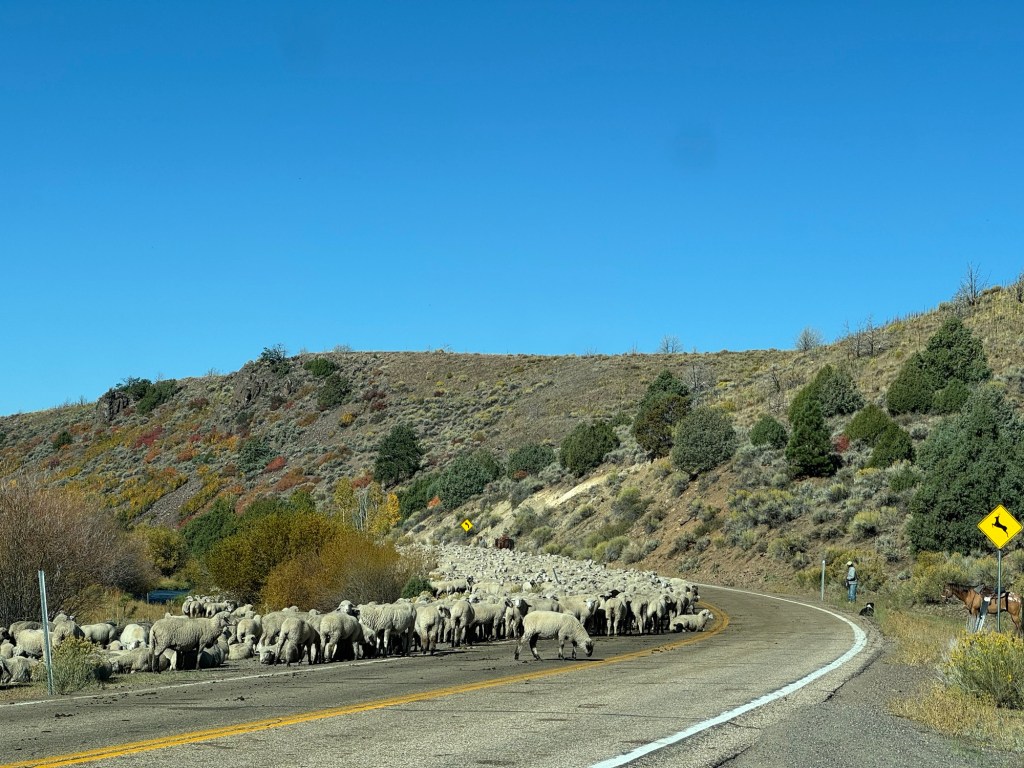
On Saturday, on the advice of one of the volunteers at the Red Canyon visitor centre, we headed west towards Cedar City. We needed fuel and groceries but the volunteer told us the aspens were in peak along Hwy 143. This route would take us through another national monument and up to higher elevations again. We headed north on Hwy 89 and then west on Hwy 143 at Panguitch. We hadn’t gone too far when we came around a bend and immediately had to come to a stop!
You’ve heard of a bear jam? This was a sheep jam!
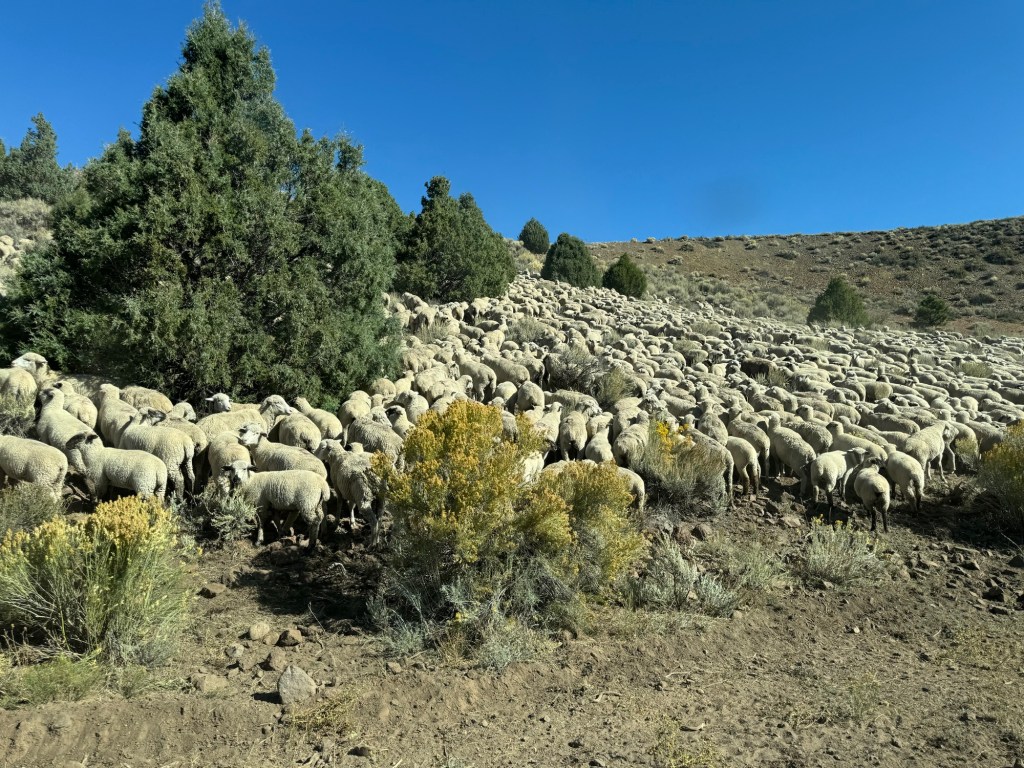
There were a couple of shepherds on horseback who were moving hundreds of sheep to another pasture. They had a few herding dogs; some were working better than others!
A few sheep on the other side of the river weren’t cooperating and the herding dog wasn’t doing its job either! It took the shepherd on his horse to get them to cross the river!All off the road and heading uphill.
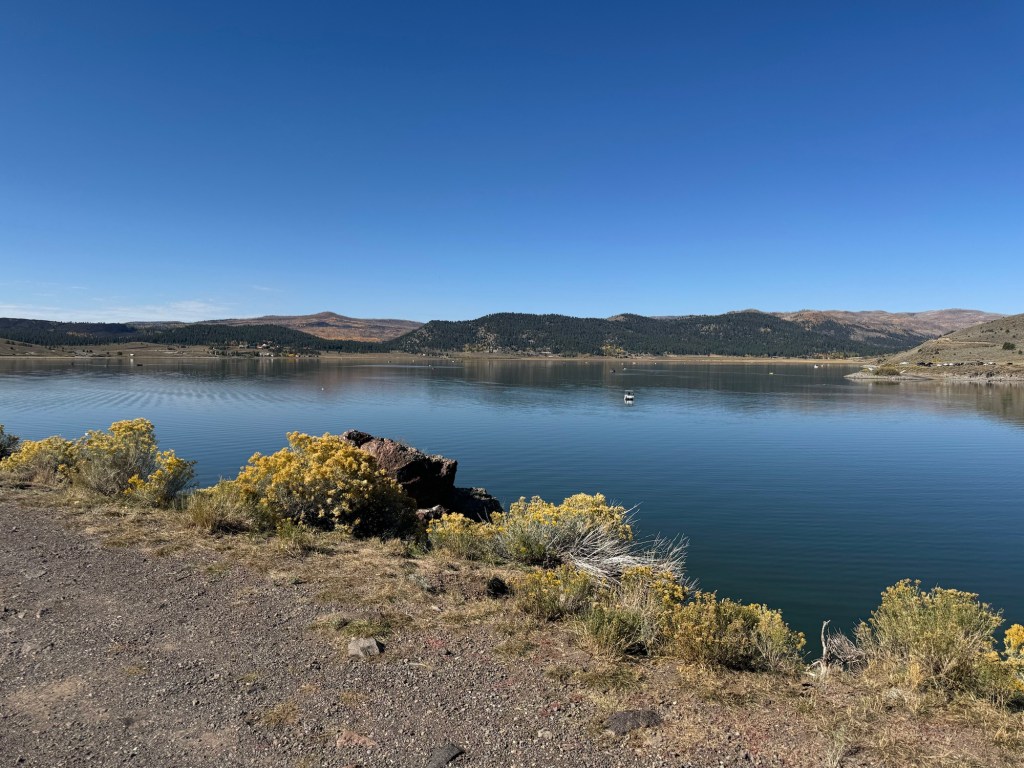
Next came Panguitch Lake.
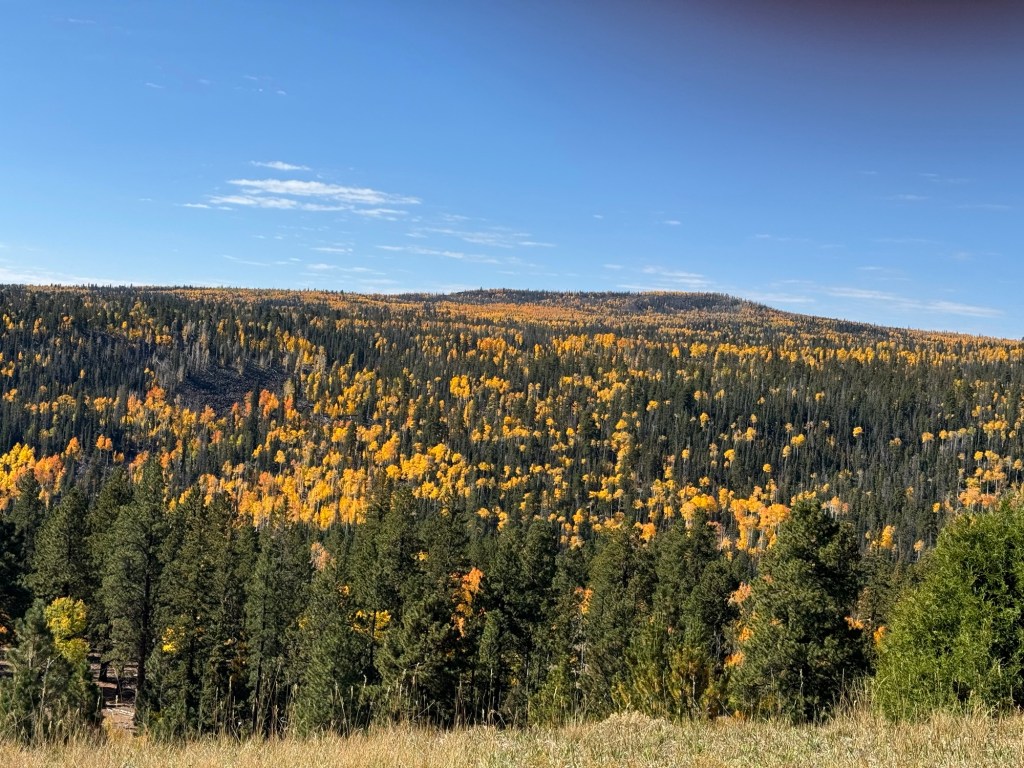
Finally we started to see the aspens!
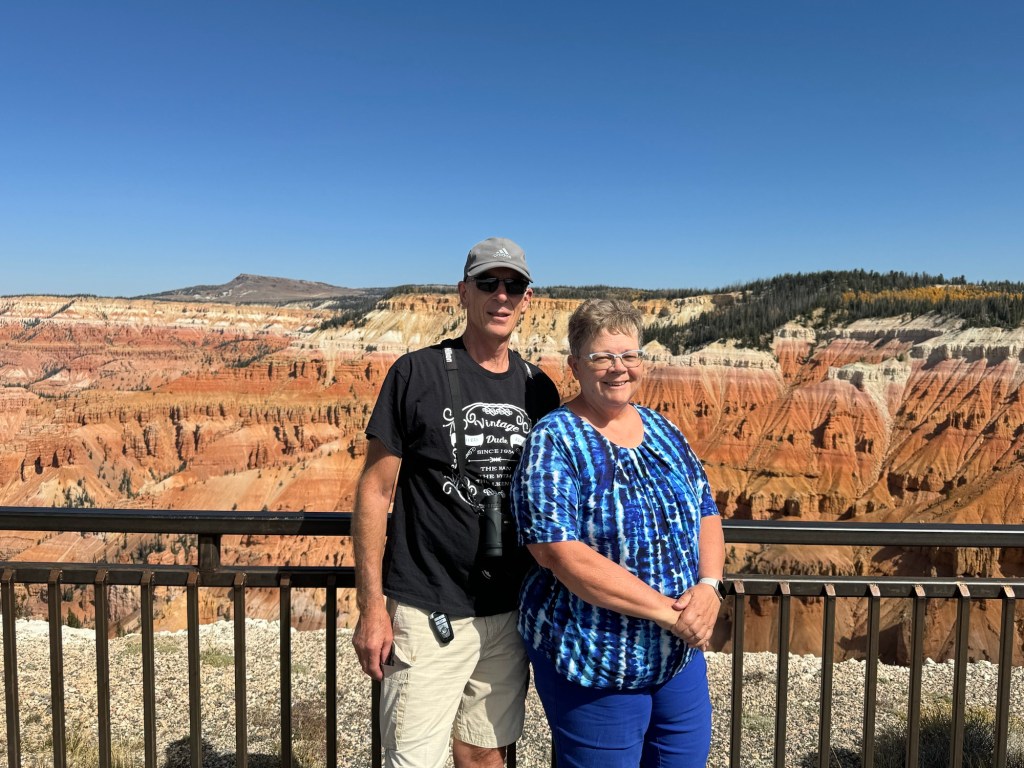
Just after seeing the aspens, we arrived at Cedar Breaks National Monument. At over 10,000’ elevation, the view from Sunset Lookout was spectacular.
The view is three miles wide and 2500’ deep. We had a great viewing day!
At Point Supreme Lookout, Cedar Breaks National Monument. Elevation 11,000’.
We carried on towards Cedar City where the rock formations changed.
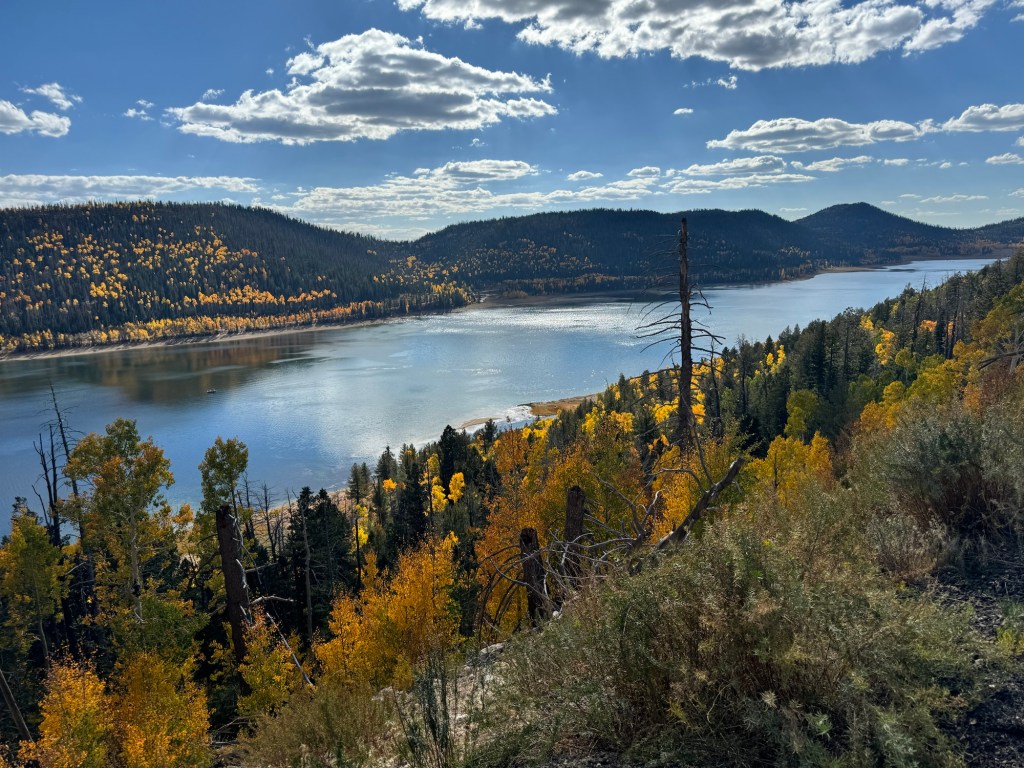
After stopping in Cedar City for fuel and groceries, we headed back Hwy 14 where we saw more aspens as well as Navajo Lake.
Navajo Lake was formed when prehistoric lava eruptions dammed the east side of the valley. Lava fields.
Our day had a perfect ending. We ate supper by the fire and then finally had a beautiful sunset!
Sunday was a day of rest and preparation for our move on Monday.
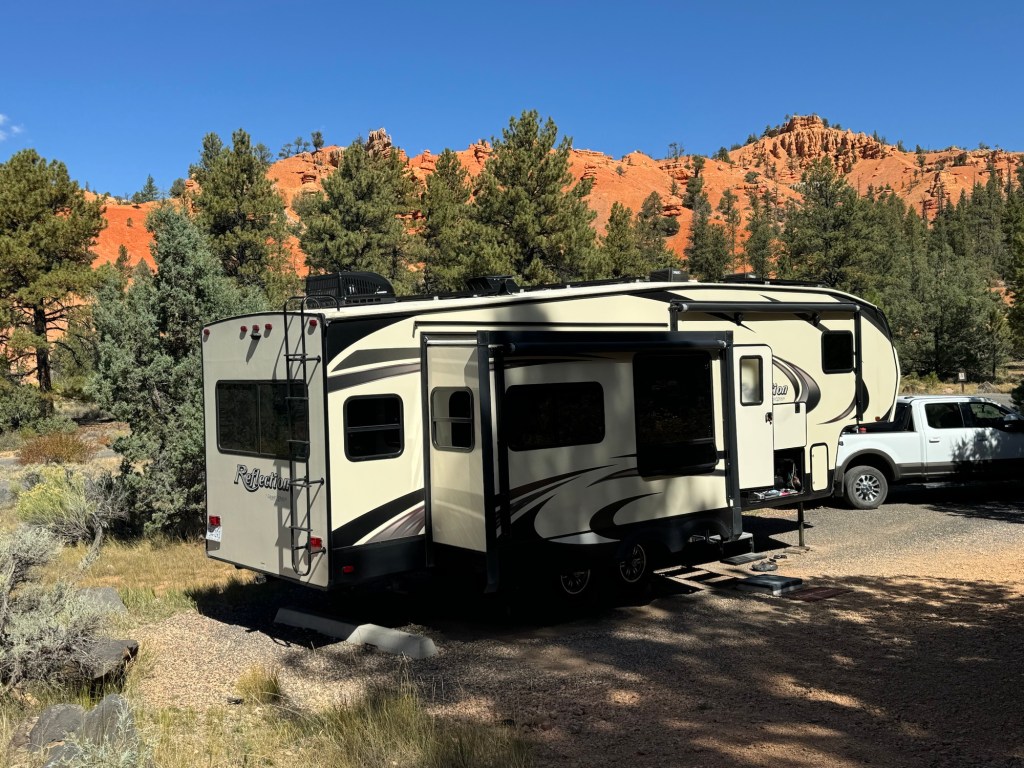
Thursday morning we got up early and after a quick breakfast, headed north. Arriving at our destination of Red Canyon National Forest, shortly after 10 am, we started driving the campground loops hoping for a spot our trailer would fit. With only 38 sites in total, we were fortunate to find one that not only was long enough for us to fit into, but the orientation was good for our solar and we weren’t right along the highway. We took the first one we came to and by noon, there were no sites left for new campers.
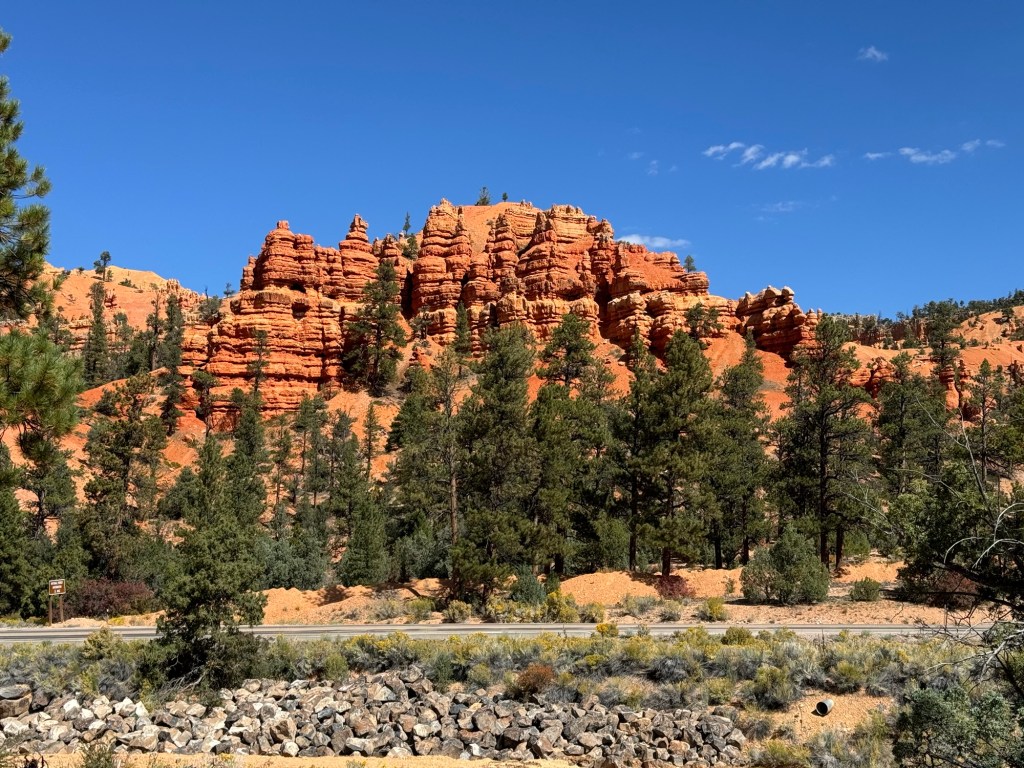
Red Canyon N.F. campground – site 29The rocks that gave the area its name.
After setting up the trailer and getting a bit of lunch, we headed out for some exploring. A visit across the road at the visitor centre gave us a couple of areas to check out for dispersed camping. We thought we’d look at the possibilities given we were going to be in the area for 4 nights. The first, Tom’s Best Spring Dispersed had many forest road loops. The main road in, #117, was well maintained and there were lots of campfire areas suitable for larger trailers. Many were already taken late Thursday afternoon. Most had some shade but you could easily have enough sun for recharging batteries. The loops off the main road got into some beautiful spots, some along the ridge with wonderful lookouts, but hard to navigate through the trees with a large trailer. We were, however, easily able to get some firewood for a campfire.
The second area, Dave’s Hollow Dispersed, we went in on the lower area on the advice of the volunteer at the visitor centre. She had her trailer parked there for the season. However, we didn’t find as many good sites there. After discussing it, Paul and I decided to stay all 4 nights at Red Canyon Campground where we were set up. Our site was nice and, being an actual regulated campground, we felt more secure leaving the trailer during our day trips.
We enjoyed eating supper outside that night and having a nice campfire.
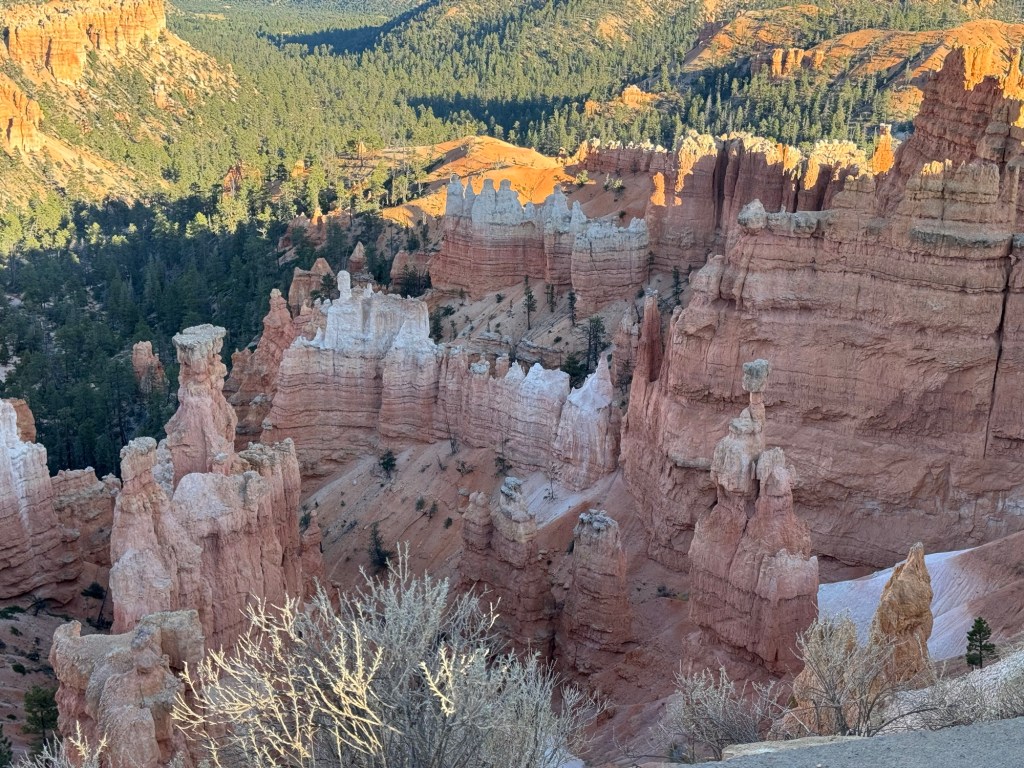
Friday morning we had another early morning so we could make the trip into Bryce Canyon National Park. Bryce is well known for the rock formations called hoodoos. Established as a National Park in 1928, it is the largest collection of hoodoos in the world. There are also some in Goblin Valley in Utah, and also somewhere in Turkey and New Zealand. It was named after a couple who came to the area in 1875 to live and harvest timber on the plateau. Bryce was his last name and his neighbours called the canyon behind his home, Bryce’s Canyon.
Lots of hoodoos
Hoodoos are formed due to a combination of factors. The various layers of rock mean some areas are more prone to erosion than others,causing water runoff to create gullies. The remaining hard rock is known as fins.. The freeze and thaw cycle makes larger cracks in these fins, and eventually a hoodoo is formed. At some points the hoodoo may actually break off when the erosion is too significant.
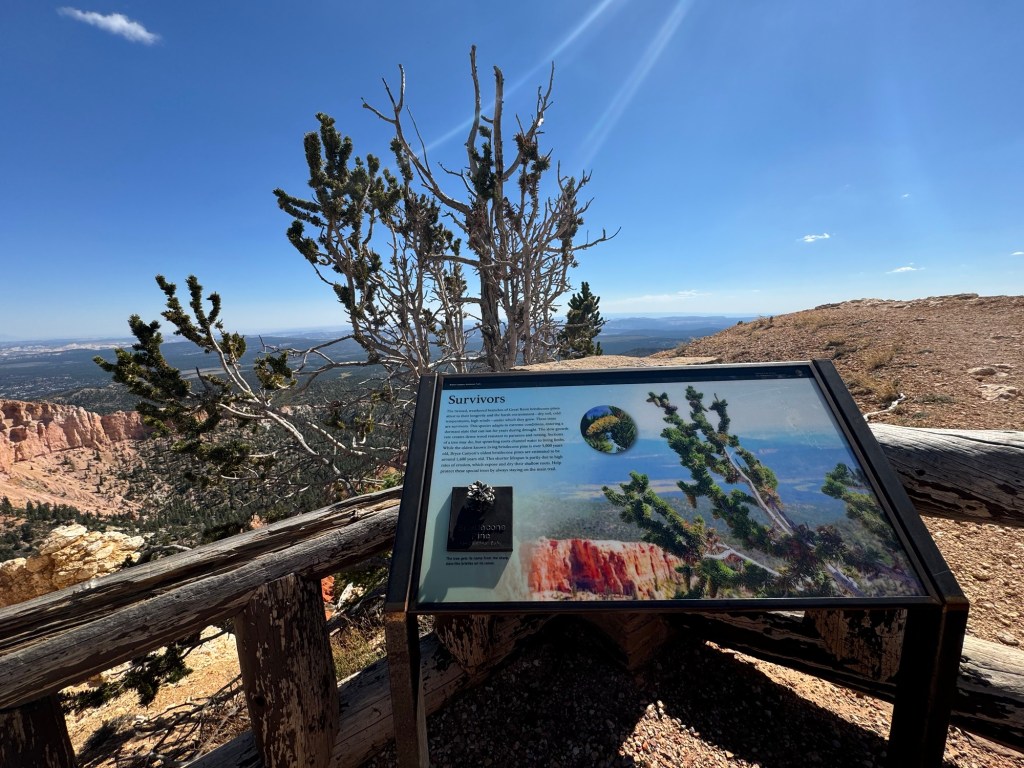
We did hike a trail while in Bryce. Called the Bristlecone Trail, it highlights there trees that in some cases may be 5000 years old!, although here the oldest known is 1200 years old.
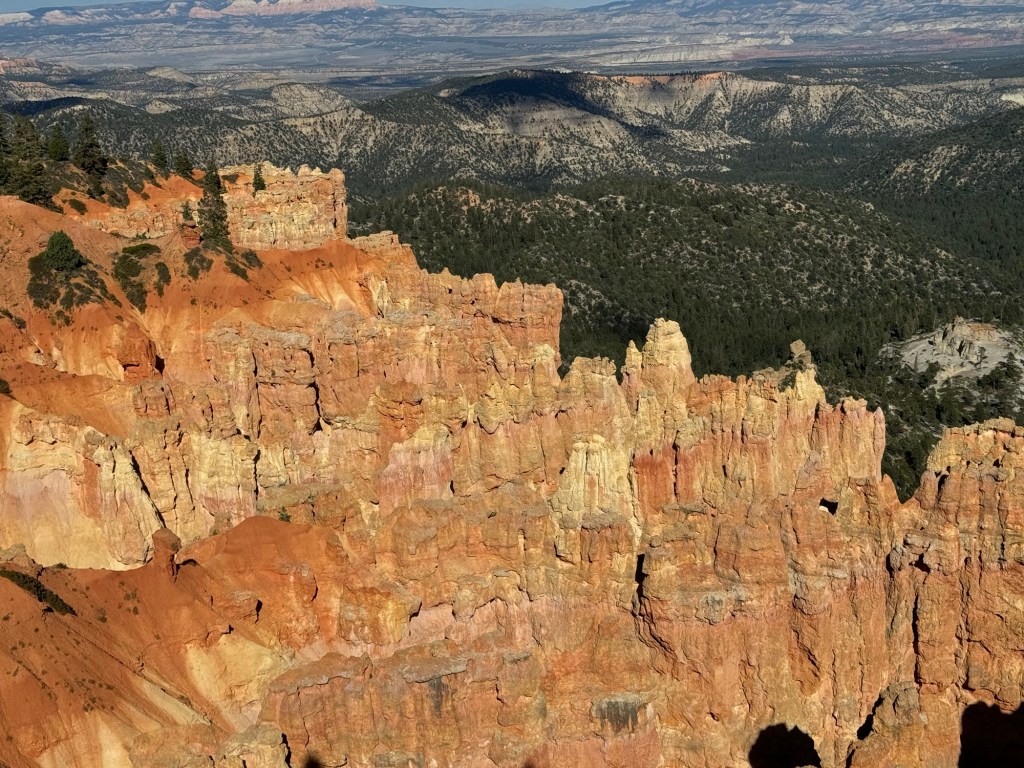
Bristlecone pine treeView from Ponderosa Lookout
One day at Bryce doesn’t allow enough time to see everything, but we decided since we had been before, we would explore a different area on Wednesday. Stay tuned!




 Following Joyce & Paul's Travels in Retirement